

- Consulting
- Data Science & AI
- M2 Solutions
- AI
Why AI Projects Don't Fail on Technology
AI projects fail because of processes, not algorithms. We show why good governance determines the success or failure of AI initiatives – and how a…
Read more
You know exactly which dashboard your department is missing. You also know that a public tender for it takes months, requires multiple bids, and often barely pays off for a small project.
Since July 1, 2026, this has changed for many cases. Federal agencies in Germany may now award contracts of up to EUR 50,000 net directly, without a competitive bidding process. Previously, the threshold was EUR 15,000. States and municipalities have their own thresholds, some of which are already higher. Check in advance which rule applies to your organization.
However, the higher threshold is not a license to simply split a long-term need into separate years. Under Section 3 of the German Public Procurement Regulation (VgV), the estimated contract value generally includes the total value, including options and contract extensions. For recurring services, the combined value of all successive contracts counts. For contracts without a total price, with an indefinite term, or with a term exceeding 48 months, the value is usually calculated as 48 times the monthly value. In concrete terms: an annual license invoice of EUR 25,000 does not automatically count as a standalone contract of EUR 25,000 if it is already foreseeable that the need will persist for several years. The procurement law assessment remains the responsibility of the relevant contracting authority.
This doesn't mean a starter project within the threshold is impossible. It means the scope has to be right: a time-limited pilot, a dashboard MVP for one department, a BI assessment, or a clearly defined training project. This is exactly where it's decided whether the EUR 50,000 achieves something or gets lost in the wrong ambition.
Many data initiatives start with a big goal: a central platform for all business processes, unified metrics across the entire organization. That can be the right call long-term, but it's usually too large for a starting point. A EUR 50,000 project needs a narrower scope: a clear business question, a manageable group of users, an outcome that can actually be used within a fixed time frame.
That question might be how case numbers and processing times are developing, where backlogs are forming, or how to automate a recurring quarterly report that's currently compiled by hand in Excel. So the starting point isn't a tool name. It's a decision that today gets made too late, or on too uncertain a data basis.
That's why we think of the budget as a set of building blocks: individual components that work on their own but can still be combined. This first article covers the visibility building block — how data becomes a dashboard that people actually use.

Tableau Server and Amazon QuickSight can both make data accessible to business units and executives, but they follow different operating models. The decision shouldn't hinge on individual features. What matters more is the existing infrastructure, security requirements, in-house expertise, and the question of who will operate the solution going forward.
Tableau Server runs in your own data center or your own cloud infrastructure, on Windows or Linux. If needed, operations can be distributed across multiple systems for higher availability. This model fits well when data sources are only reachable within the internal network, when existing security concepts need to keep being used, or when the organization prefers to administer its own BI platform. Tableau offers tiered license roles for this: Creator for people who connect data and develop content. Explorer for people who edit existing content and add their own analyses. Viewer for people who only view published content. This way, the license model matches the actual roles within the department, instead of everyone getting the same, more expensive license.
Amazon QuickSight is a fully managed BI service in the AWS cloud, with no server of your own to run. Administration is still needed for users, data access, network connections, and cost control. This model is a good fit when data or applications already reside in AWS, when you don't want to set up your own server, or when dashboards need to be embedded into an existing portal. In the Enterprise edition, QuickSight can be connected to internal data sources via a private cloud connection. This requires suitable network connections and is part of the security and cloud architecture.
Our take: Tableau Server and QuickSight are not interchangeable products. Tableau fits an organization that wants to operate its own BI infrastructure. QuickSight plays to its strengths when AWS is already part of the target architecture or when a managed cloud solution is what's needed. The technology follows the operating model and the use case — not the other way around. A budget of up to EUR 50,000 should not be spent trying to build an organization-wide BI landscape all at once. A solid first expansion stage for one department is more realistic. It shows whether data sources, role model, technology, and ways of working fit together before other departments follow.
The exact scope depends on data quality, the number of sources, and existing infrastructure. A realistic project goal can look like this: one department gets a dashboard that's ready for productive use, along with a documented data model, regulated access, and enough in-house knowledge to maintain the solution independently day to day. That's more than a prototype built on sample data. But it's not yet a complete data program for the entire agency.
Four things are especially important here:
M2 supports data and analytics projects beyond the visible dashboard layer. Depending on the starting point, this ranges from business conception through architecture and data engineering to visual design and enablement. These areas are interconnected. A good dashboard needs reliable data, a suitable infrastructure, and people who can use it day to day. We have many years of experience with Tableau, AWS-based analytics platforms, and data projects in the public sector, from individual dashboards to the modernization of entire BI infrastructures.
You can find an overview of our portfolio here: M2/enablement
The new threshold doesn't hand you a finished data strategy. But it does make it easier to get started with a manageable project: define the business question, limit the group of users and data sources, choose an operating model, develop a report that's actually used, establish clear ownership, and empower employees.
If you'd like to work out which reporting or analytics process is a good fit for a starting point like this, we're available to help — with no obligation. In a free, no-commitment introductory call, we'll look together at where the most manual effort is happening today, which data sources are relevant, and what outcome is realistic within your budget. Get the visibility building block right now, and you'll have the choice next time — wait, and you'll be deciding under time pressure. Part two of the series shows how much more is possible once the dashboard no longer has to wait on its data: the speed building block with Exasol.
AI projects fail because of processes, not algorithms. We show why good governance determines the success or failure of AI initiatives – and how a…
Read more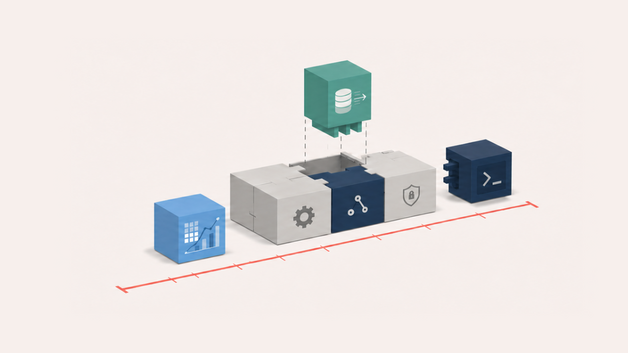
A dashboard can be factually correct and still fail. We show how a budget of up to €50,000 can transform the data foundation behind it.
Read more
We show what Tableau and Amazon QuickSight make possible.
Read more
How government agencies are putting data to use faster, more clearly, and more cost-effectively.
Read more